For younger residents of Krapkowice, the building at 3 Młyńska Street is primarily associated with the modern Zamkowy Młyn hotel and restaurant. Older residents, however, vividly remember the days when flour was still ground here. Read the story of the mill in Krapkowice's market square, whose history dates back to... the 13th century!
13th-15th centuries. The beginnings of Krapkowice and the establishment of the Lower Mill.
To tell the story of the Castle Mill, we must go back to the history of Krapkowice itself. The first mention of Chrapkowice (at that time) dates back to the 13th century, and in 1284 the settlement was granted town rights under Magdeburg Law. Although the exact date of the mill's construction is unknown, it is likely that it was built in the penultimate decade of the 13th century, on a par with the castle being built at that timeTogether with two other mills, it supplied the manor, the town, and the surrounding villages. Due to its location, The Castle Mill was also referred to as the Lower Mill.
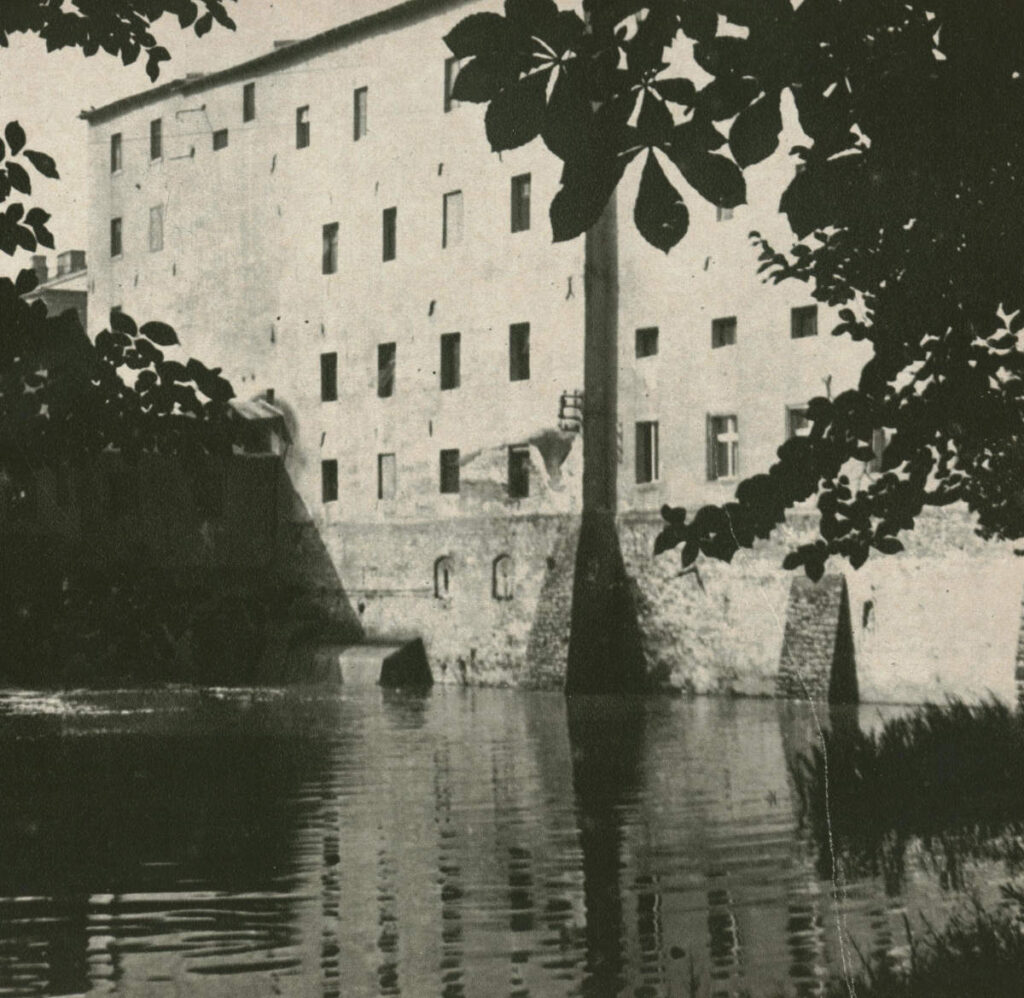
To operate such a mill, one had to possess the appropriate experience and skills. As you might imagine, for decades to come, the mill at the Castle was operated by the best millers, who received substantial remuneration for their work, ensuring a high standard of living for their families.
16th-17th century. The Castle Mill in the "service" of the Emperor
Thanks to the Krapkowice urbarium (and the work of Johannes Chrząszcz), compiled at the behest of Prince George of Hohenzollern in the mid-16th century, it is possible to chart the efficiency of Krapkowice's mills. At the time, an urbarium was a book containing a list of a landowner's assets. It turned out that the millers from the Middle and Upper Mills were required to annually deliver 2.5 mandrat of rye flour to the prince, along with specific amounts of pigs and malt, while Gregor, the miller from the Lower (Castle) Mill, delivered 20 percent less flour. This may have been due to a privileged position, or it may have been related to the needs of the castle itself and its inhabitants.
During the period in question, Krapkowice was under imperial rule, then under burgher rule, and finally the city was returned to the emperor. As we know from the next urbarium, At the end of the 16th century, the emperor owned the Upper and Lower (Castle) mills. From 1582, Krapkowice belonged to the von Redern family, and from 1762 to the von Haugwitz family, and together with the town – the Castle Mill, which constantly fulfilled its essential function, supplying flour to the court and the inhabitants.
18th-19th centuries. The Salzbrunn era and the mill's time of great splendor.
The fate of the Castle Mill and its subsequent owners is unknown until the mid-18th century, when the lease rights to the mill were purchased by Franz Gniza, who sold the mill to Hans Georg Heptner in 1790. In 1806, a turning point came for the mill – its lease was sold to Lorenz Salzbrunn.At that time, the Castle Mill had two wheels—one for grinding flour and the other for cutting boards—as well as a press and a tannery. The mill was taken over in 1852 (until then, it had been held under a perpetual lease). From that point on, the new owners were obligated to pay an annual annuity to the count's manor for the next 56 years.
It's worth noting that the worn-out and heavily used mill was in increasingly poor condition. Its rightful owner, Karl Salzbrunn, undertook a thorough renovation in 1853, increasing its efficiency. In subsequent years, his income increased as the millers' influence grew. These were the mill's heyday, and the Salzbrunn family operated it for almost 150 years, until World War II.
The Salzbrunns soon became one of the wealthiest families in the area, acquiring further properties – a tenement house on Kościelna Street in Krapkowice, and probably owning shares in quarries and lime kilns. The next milestone in the development of the mill (and thus the Salzbrunn family) took place at the turn of the century, when Eugen Salzbrunn, just 21 years old, started managing the family business.
20th Century: Ominous Fire and the "Gracious" Second World War
The turn of the 19th and 20th centuries was a time of expansion and modernization of the mill, in which a modern turbine driven by a central shaft and a generator was installed, thanks to which the mill was the first power plant in KrapkowiceThe enterprising Eugen Salzbrunn, wanting to commemorate his contribution, placed a tin time capsule with the initials "ES 1889" under the foundations. The mill supplied electricity to several buildings located on Krapkowice's market square.
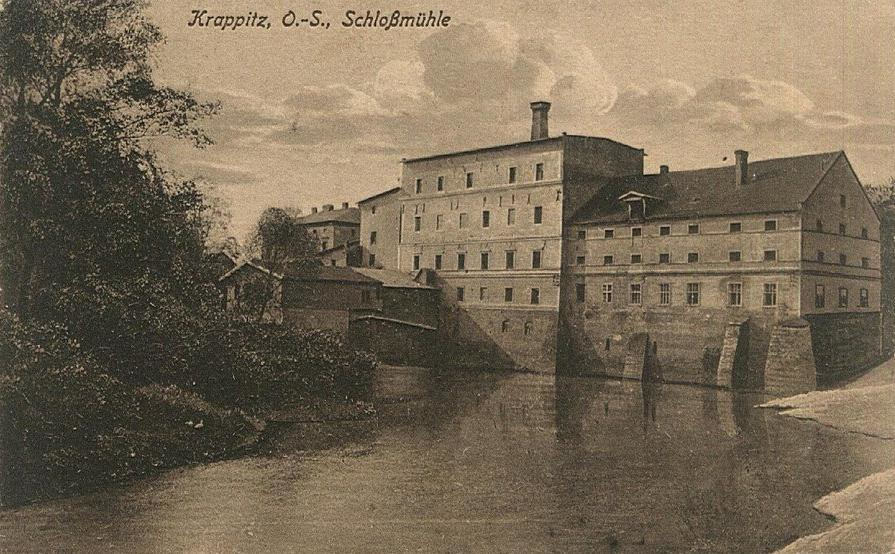
Shortly thereafter, a second generator was installed, and Eugen Salzbrunn became deeply involved in the lime industry, utilizing the new Opole–Strzelce Opolskie railway line. Both Salzbrunn and other entrepreneurs from Krapkowice were building kilns at the time, enabling the rebirth of the Tarnów limestone center.
Another renovation of the mill and its machinery took place in 1912. Despite the town of Krapkowice having its own municipal power plant, Salzbrunn was able to continue selling electricity and even increase production. It was not until Krapkowice was integrated into the national power grid in 1926 that the importance of Zamkowy Młyn as a power supplier diminished.
The fateful day for the history of the Castle Mill was March 8, 1923, when a great fire broke out. It destroyed the mill, the power plant, and the warehouse. With ample capital and insurance funds at its disposal, Salzbrunn rebuilt and modernized the mill before the end of the year.
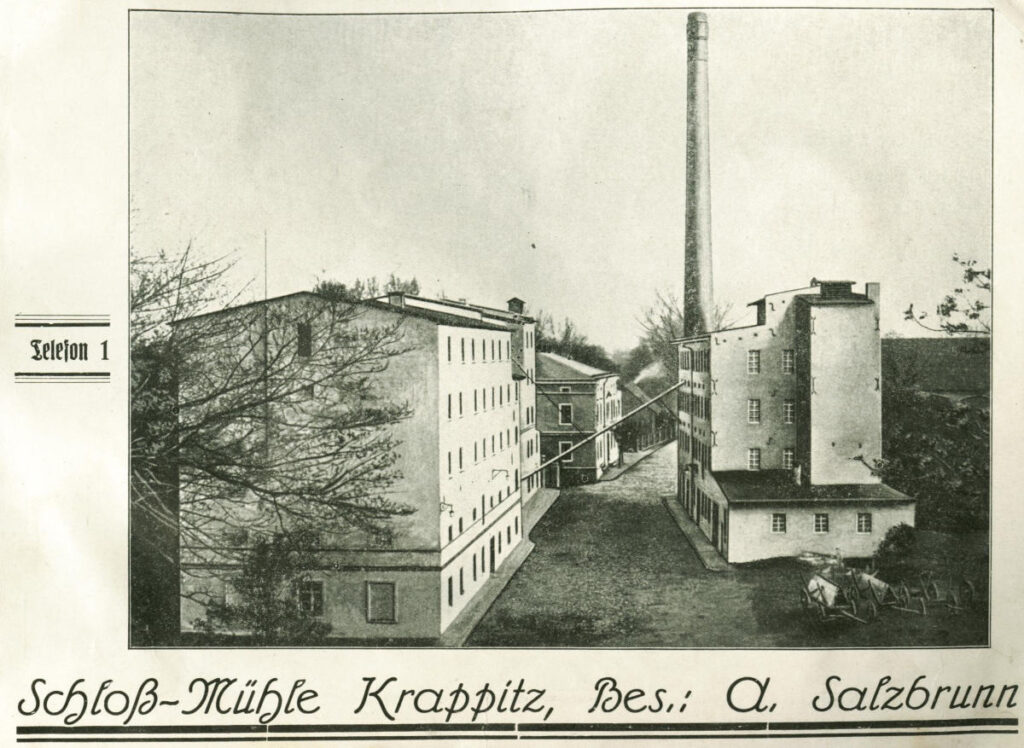
Eugen Salzbrunn died in October 1939, shortly after the outbreak of World War II. Having no son, he had already handed the company over to his son-in-law, Gunter von Stein, several years earlier. The bloody events of World War II turned out to be "kind" to the Castle MillDespite being directly on the front line at the beginning of 1945, no serious damage occurred. It was also one of the few plants in Krapkowice that was not looted by Red Army soldiers. Moreover, they restored the facility and handed it over to the Polish administration in good condition. As for the fate of the Salzbrunn family (and later the von Stein family), they had to evacuate to Germany before the war, and their property was nationalized.
21st Century: The Second Life of the Castle Mill
After the war, the Castle Mill was taken over by the State Grain Works in Brzeg, and although its technical condition left much to be desired, it continued to serve its essential purpose well into the 1990s. Immediately after the Mill's privatization, it stood empty for several years and fell into disrepair.
Fortunately, after a period of inactivity and decay, new owners were found for the building (the family company DELTA WGW Sp.j.), thanks to which this building, important for the history of Krapkowice, was given a "second life." After a thorough renovation and adaptation of the former mill, in 2011 a well-known and popular mill was built there in the region. Hotel Castle Mill along with Zamkowy Młyn Restaurant, which set itself the goal of welcoming not only hotel guests but also guests from across the region and further afield. Thus began a new story, one we continue to create today.
The article was based on own materials provided by local historians and on an article in the local weekly "Nowiny Krapkowice".